Medication Line
Medication Line
- Medication Line
- Quick Implementation Guide
- Edition 1 20 [th] May 2010
- Formatting Drug Names
- Display generic drug names in bold
- Display generic drug names in lowercase (capital letters may still be used for acronyms and abbreviations in some drug names such as amphotericin B, factor VIII, carbomer 974P)
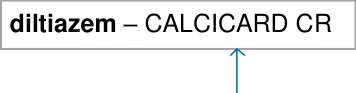
- Display drug brand names in uppercase
- Where both the generic name and the brand name appear in a medication line, list the generic name first
- 4
- Displaying Numbers
- Where possible, avoid the need for decimal points by changing the units without breaking convention
- Do not put a trailing zero after a sub-decimal value (that is, ‘0.5’ is correct but ‘0.50’ is incorrect)
- Put a leading zero before a decimal point for values of less than one
- Use a comma to break up numeric values of one thousand and above
- 5
- Separators
- When combining attributes in a
- every 6 hours text string, use a long dash (em dash) surrounded by spaces between the attributes
- Use a double space instead of a long dash or separator between a drug name and strength when there are multiple drug names in one medication line
- Use a double space instead of a long dash or separator between a drug name and strength when the strength is expressed as a percentage
- 6
- Wrapping
- When wrapping the text of a medication line, do so without breaking up the contents of a attribute will not fit on one line
- Do not allow wrapping to separate a label from a value
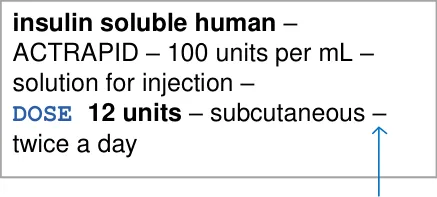
- When wrapping the text of a medication line, keep trailing delimiters with the preceding attribute
- If a long drug name exceeds the available screen space and has to be wrapped, ensure that the drug name is wrapped between words
- 7
- Abbreviation
- Truncation
- Symbols
- Do not use symbols that may be confused with numbers or otherwise misinterpreted, including those illustrated
- Use the ‘+’ (plus symbol) only for multiple drug name medications and surround it with spaces. When a ‘+’ is displayed adjacent to a ‘4’, separate the two with a double space
- Use alternatives such as a dash or a black dot (�) instead of brackets and separators such as those illustrated that look like the number one
- 10
- Text Labels
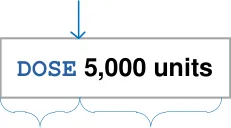
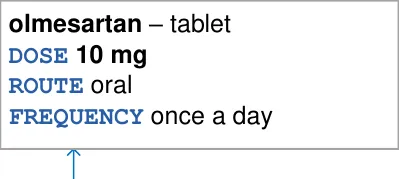
- Use a different font and colour to differentiate labels from values
- Use a space to separate a label from a value
- Do not use a colon after a label
- Display labels in uppercase
- 11
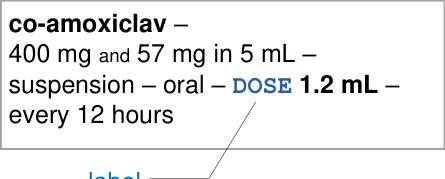
- Keep the number of text labels in a medication represented as a single-text sentence to a minimum
- When a medication is represented as a single-text sentence, use a label for dose only
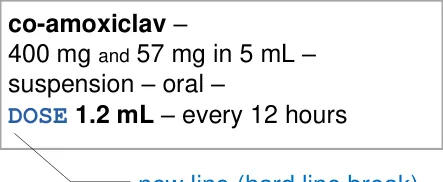
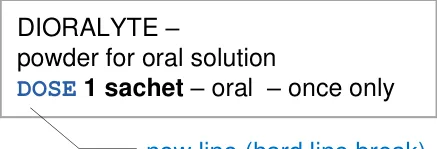
- When a medication is represented as a series of lines with hard line breaks, labels should appear at the beginning of a new line after a hard line break
- 12
- Line Breaks
- Line Spacing
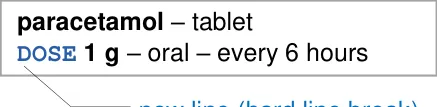
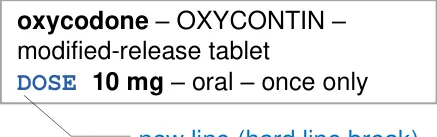
- When displaying a medication as one or many lines of text, preserve white space between the lines by ensuring that the line height is no less than 120% (120% leading) and no greater than 140% (140% leading)
- When displaying a list of medications, ensure that there is a space equivalent to at least one line height of 100% between the last line of one medication line and the first line of the medication line below
- 14
- Displaying Dose
- 15
- Provide a text label that reads ‘DOSE’ before a dose
- Display the dose amount and units in bold
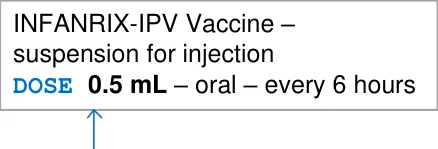
- When a dose is expressed as a volume, display the volume amount in bold
- When there is no dose or volume, display a dose equivalent in place of the dose and subject to the same guidance points as a dose. Precede with an appropriate text label
- Separate the dose amount from the dose units with a space
- Do not put a trailing zero after a sub-decimal value when displaying a dose amount (that is, ‘0.5’ is correct but ‘0.50’ is incorrect)
- Put a leading zero before a decimal point for values of less than one when displaying a dose value
- Use a comma to break up numeric values of one thousand and above when displaying a dose value
- 16
- Displaying Strength
- 17
- When describing strengths with an active ingredient in a fluid, use ‘in’ rather than a forward slash ( ‘/’ ) before the fluid quantity
- When describing strengths of an ingredient in a single unit of fluid, use the word ‘per’ to describe the unit of fluid
- When describing a strength for a combination drug whose two strength values use the same unit (such as mg), use the word ‘and’ in a smaller font to join the two strength values and display the units after the second strength value
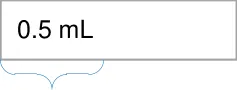
- Do not put a trailing zero after a decimal point when displaying numbers in a strength value
- Put a leading zero before a decimal point for values of less than one when displaying numbers in a strength value
- heparin – 5,000 units per mL – Use a comma to break up
- numeric values of one thousand
- and above when displaying
- numbers in a strength value
- 18
- Attribute Order
- When describing a medication as a line of text, adhere to the order illustrated for the display of the medication attributes (as applicable)
- 19
- When designing for specific contexts, especially those that need additional text labels and line breaks, display drug name first and display other attributes (in a different order if necessary) from the one defined above
- When a medication is not displayed as a single line of text and the attributes of a medication are listed in a different order, use text labels for as many of the illustrated attributes as possible
- 20
- Quick Implementation Guide
Source PDF: medlineqig.pdf
Quick Implementation Guide
Edition 1 20 [th] May 2010
This document was prepared for NHS Connecting for Health which ceased to exist on 31 March 2013. It may contain references to organisations, projects and other initiatives which also no longer exist. If you have any questions relating to any such references, or to any other aspect of the content, please contact cuistakeholder.mailbox@hscic.gov.uk Copyright: You may re-use this information (excluding logos) free of charge in any format or medium, under the terms of the Open Government Licence. To view this licence, visit nationalarchives.gov.uk/doc/open-governmentlicence or email psi@nationalarchives.gsi.gov.uk.
1
Copyright ©2013 Health and Social Care Information Centre
Introduction Introduction
Medications may be represented electronically in varying degrees of detail as well as in different areas of a user interface. For example:
§ A prescription summary displayed as part of a patient summary
§ A subset of prescription detail displayed in a list of a patient’s current
medications
§ A different subset of prescription detail displayed in an electronic drug
administration schedule
A text description of a medication appearing in such views is referred to in this guidance as a ‘medication line’. The guidance in this document details the content, formatting and layout of medication lines. The guidance applies to all views intended to support medications management for a single patient in a hospital ward
Important
Although it contains all of the guidance points, this document omits supporting information and is therefore not intended as a substitute for the full NHS CUI documents Medication Line [1] . Refer to that document for the definitive statement of the design guidance in this area.
The visual representations used to display the guidance are illustrative only. Stylistic choices (for example, display font used), unless otherwise specified, are not part of the guidance and are therefore not mandatory requirements.
1 Medications Management – Medication Line – User Interface Design Guidance (v2.0.0.0)
Copyright ©2013 Health and Social Care Information Centre
2
Introduction
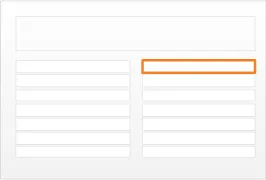
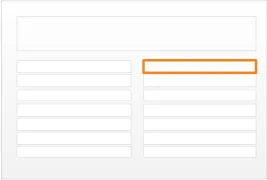
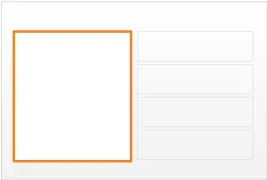
The following examples show how the guidance can be applied to four different styles of medication line in four notional views:
View 1
Medication Line 1
diltiazem - CALCICARD CR – modified-release tablet – DOSE 120 mg - oral – three times a day
View 2
View 3
View 4
Medication Line 2
diltiazem - CALCICARD CR – modified-release tablet DOSE 120 mg ROUTE oral – three times a day
Medication Line 3
diltiazem - CALCICARD CR – modified-release tablet DOSE 120 mg - oral – three times a day
Medication Line 4
diltiazem - CALCICARD CR FORM modified-release tablet DOSE 120 mg ROUTE oral FREQUENCY three times a day
Copyright ©2013 Health and Social Care Information Centre
3

Guidance
Formatting Drug Names
MEDi-001
Display generic drug names in bold
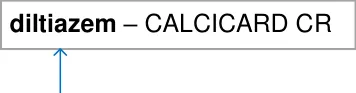
bold
Mandatory
MEDi-002
| diltiazem – CALCICARD CR | Col2 |
|---|---|
lowercase
Display generic drug names in lowercase (capital letters may still be used for acronyms and abbreviations in some drug names such as amphotericin B, factor VIII, carbomer 974P)
Mandatory
MEDi-003
Display drug brand names in uppercase
uppercase
Mandatory
MEDi-013
generic name
(first)
brand name
Where both the generic name and the brand name appear in a medication line, list the generic name first
Mandatory
Copyright ©2013 Health and Social Care Information Centre
4
Guidance
Displaying Numbers
paracetamol - tablet DOSE 1 g - oral – every 6 hours
paracetamol - tablet DOSE 500 mg - oral – every 6 hours
INFANRIX-IPV Vaccine – suspension for injection DOSE 0.5 mL - oral – every 6 hours
MEDi-014
Where possible, avoid the need for decimal points by changing the units without breaking convention
Recommended
MEDi-015
Do not put a trailing zero after a sub-decimal value (that is, ‘0.5’ is correct but ‘0.50’ is incorrect)
Mandatory
MEDi-016
Put a leading zero before a decimal point for values of less than one
Mandatory
MEDi-017
| DOSE 5,000 units | Col2 |
|---|---|
comma
Use a comma to break up numeric values of one thousand and above
Mandatory
5
Copyright ©2013 Health and Social Care Information Centre
Guidance
Separators
MEDi-018 paracetamol - 120 mg in 5 mL –
When combining attributes in a
suspension – DOSE 80 mg - oral –
every 6 hours text string, use a long dash (em dash) surrounded by spaces between the attributes
Mandatory
double spaces
MEDi-019
Use a double space instead of a long dash or separator between a drug name and strength when there are multiple drug names in one medication line
Recommended
MEDi-020
Use a double space instead of a long dash or separator between a drug name and strength when the strength is expressed as a percentage
Recommended
| Col1 | Col2 | Col3 |
|---|---|---|
| paracetamol 500 mg + metoclopramide 5 mg – sachet – DOSE 2 sachets – oral –every 4 hours as required – maximum 6 doses in 24 hours | paracetamol 500 mg + metoclopramide 5 mg – sachet – DOSE 2 sachets – oral –every 4 hours as required – maximum 6 doses in 24 hours | paracetamol 500 mg + metoclopramide 5 mg – sachet – DOSE 2 sachets – oral –every 4 hours as required – maximum 6 doses in 24 hours |
| double | space |
|---|---|
sodium chloride 0.9% – infusion –VOLUME 1,000 mL – 40 mL per hour –over 12 hours – intravenous – once only | sodium chloride 0.9% – infusion –VOLUME 1,000 mL – 40 mL per hour –over 12 hours – intravenous – once only |
Copyright ©2013 Health and Social Care Information Centre
6
Guidance
Wrapping
MEDi-010
When wrapping the text of a medication line, do so without breaking up the contents of a attribute will not fit on one line
Mandatory
MEDi-008
Do not allow wrapping to separate a label from a value
Mandatory
MEDi-011
| insulin soluble human | Col2 | Col3 |
|---|---|---|
| ACTRAPID | – | 100 units per mL |
| solution for injection | solution for injection | solution for injection |
DOSE12 units | DOSE12 units | DOSE12 units |
| twice a day | twice a day | twice a day |
trailing delimiter
haemophilus influenzae type B vaccine solution for injection – DOSE 0.5 mL intramuscular – once only
When wrapping the text of a medication line, keep trailing delimiters with the preceding attribute
Mandatory
MEDi-021
If a long drug name exceeds the available screen space and has to be wrapped, ensure that the drug name is wrapped between words
Mandatory
Copyright ©2013 Health and Social Care Information Centre
7
Abbreviation
paracetamol 500 mg + metoclopramide 5 mg – sachet – oral – DOSE 2 sachets every 4 hours as required – maximum 6 doses in 24 hours
sodium chloride 0.9% – infusion – VOLUME 1,000 mL 40 mL per hour – over 8 hours – intravenous – once only
Guidance
MEDi-022
Do not abbreviate drug names
Mandatory
MEDi-023
Use long form names rather than abbreviations or symbols where possible
Recommended
MEDi-024
Do not put a full stop after abbreviations for units (for example mg and mL)
Mandatory
Copyright ©2013 Health and Social Care Information Centre
8
Guidance
Truncation
cefotaxime powder for solution for injection – intravenous – DOSE 400 mg every 8 hours
9
MEDi-025
Do not truncate drug names
Mandatory
MEDi-012
If necessary, wrap but do not truncate medication line information
Mandatory
MEDi-054
Do not display a part of the medication line alone if its meaning relies on other parts that are not displayed
Mandatory
Copyright ©2013 Health and Social Care Information Centre
Guidance
Symbols
| @ | At sign |
|---|---|
| > | Greater than bracket |
| < | Less than bracket |
| / | Forward slash |
| |Backslash | |
| & | Ampersand |
| ° | Degree |
spaces
| Col1 | Col2 | Col3 |
|---|---|---|
| paracetamol500 mg + metoclopramide5 mg – sachet – oral – DOSE 2 sachets –every 4 hours as required – maximum 6 doses in 24 hours | paracetamol500 mg + metoclopramide5 mg – sachet – oral – DOSE 2 sachets –every 4 hours as required – maximum 6 doses in 24 hours | paracetamol500 mg + metoclopramide5 mg – sachet – oral – DOSE 2 sachets –every 4 hours as required – maximum 6 doses in 24 hours |
| paracetamol – tablet DOSE 1 g – oral – every 6 hours | Col2 |
|---|---|
dash
Do not use symbols that may be confused with numbers or otherwise misinterpreted, including those illustrated
Mandatory
MEDi-027
Use the ‘+’ (plus symbol) only for multiple drug name medications and surround it with spaces. When a ‘+’ is displayed adjacent to a ‘4’, separate the two with a double space
Mandatory
MEDi-028
Use alternatives such as a dash or a black dot (�) instead of brackets and separators such as those illustrated that look like the number one
Mandatory
| ( ) | Parentheses |
|---|---|
| [ ] | Brackets |
| { } | Braces |
Copyright ©2013 Health and Social Care Information Centre
10
Guidance
Text Labels
space
MEDi-009
Use a different font and colour to differentiate labels from values
Mandatory
MEDi-031
Use a space to separate a label from a value
Mandatory
MEDi-032
Do not use a colon after a label
Mandatory
MEDi-033
Display labels in uppercase
Recommended
Copyright ©2013 Health and Social Care Information Centre
label value
uppercase
11
Guidance
Text Labels
MEDi-034
Keep the number of text labels in a medication represented as a single-text sentence to a minimum
Recommended
MEDi-029
When a medication is represented as a single-text sentence, use a label for dose only
Mandatory
MEDi-030
When a medication is represented as a series of lines with hard line breaks, labels should appear at the beginning of a new line after a hard line break
Mandatory
Copyright ©2013 Health and Social Care Information Centre
12
Guidance
Line Breaks
MEDi-035
When using hard line breaks at set points (such as before a dose), do not use a long dash at the end of the previous line
Recommended
Copyright ©2013 Health and Social Care Information Centre
13
Line Spacing
Guidance
line height from 120% to 140%
MEDi-036
When displaying a medication as one or many lines of text, preserve white space between the lines by ensuring that the line height is no less than 120% (120% leading) and no greater than 140% (140% leading)
Recommended
at least 100% of line height
MEDi-037
When displaying a list of medications, ensure that there is a space equivalent to at least one line height of 100% between the last line of one medication line and the first line of the medication line below
Recommended
| Col1 | Col2 |
|---|---|
| paracetamol – tablet | |
DOSE 1 g– oral – every 6 hours | DOSE 1 g– oral – every 6 hours |
| paracetamol – tablet DOSE 1 g – oral – every 6 hours | Col2 |
|---|---|
| oxycodone– OXYCONTIN – modified-release tablet DOSE10 mg – oral – once only | oxycodone– OXYCONTIN – modified-release tablet DOSE10 mg – oral – once only |
Copyright ©2013 Health and Social Care Information Centre
14
Guidance
Displaying Dose
morphine - 2 mg in 10 mL – solution for injection – DOSE 2 mg intravenous – once only
sodium chloride 0.9% – infusion – VOLUME 1,000 mL 40 mL per hour – over 12 hours – intravenous – once only
15
MEDi-007
Provide a text label that reads ‘DOSE’ before a dose
Mandatory
MEDi-038
Display the dose amount and units in bold
Mandatory
MEDi-039
When a dose is expressed as a volume, display the volume amount in bold
Mandatory
MEDi-040
When there is no dose or volume, display a dose equivalent in place of the dose and subject to the same guidance points as a dose. Precede with an appropriate text label
Mandatory
Copyright ©2013 Health and Social Care Information Centre
Displaying Dose
| DOSE 500 mg | Col2 |
|---|---|
space
INFANRIX-IPV Vaccine – suspension for injection DOSE 0.5 mL - oral – every 6 hours
Guidance
MEDi-041
Separate the dose amount from the dose units with a space
Mandatory
MEDi-042
Do not put a trailing zero after a sub-decimal value when displaying a dose amount (that is, ‘0.5’ is correct but ‘0.50’ is incorrect)
Mandatory
MEDi-043
Put a leading zero before a decimal point for values of less than one when displaying a dose value
Mandatory
leading zero
MEDi-044
| DOSE 5,000 units | Col2 |
|---|---|
comma
Use a comma to break up numeric values of one thousand and above when displaying a dose value
Mandatory
Copyright ©2013 Health and Social Care Information Centre
16
Guidance
Displaying Strength
co-amoxiclav 400 and 57 mg in 5 mL – suspension – oral – DOSE 1.2 mL every 12 hours
heparin - 5,000 units per mL – solution for injection – DOSE 5,000 units - subcutaneous injection – once only
co-codamol - 8 and 500 mg – tablet – oral – DOSE 1 tablet every 4 to 6 hours as required
17
MEDi-045
When describing strengths with an active ingredient in a fluid, use ‘in’ rather than a forward slash ( ‘/’ ) before the fluid quantity
Mandatory
MEDi-046
When describing strengths of an ingredient in a single unit of fluid, use the word ‘per’ to describe the unit of fluid
Mandatory
MEDi-047
When describing a strength for a combination drug whose two strength values use the same unit (such as mg), use the word ‘and’ in a smaller font to join the two strength values and display the units after the second strength value
Mandatory
Copyright ©2013 Health and Social Care Information Centre
Displaying Strength
Guidance
MEDi-048
Do not put a trailing zero after a decimal point when displaying numbers in a strength value
Recommended
MEDi-049
Put a leading zero before a decimal point for values of less than one when displaying numbers in a strength value
Recommended
strength
MEDi-050
heparin – 5,000 units per mL – Use a comma to break up
solution for injection –
numeric values of one thousand
DOSE 5,000 units - subcutaneous
and above when displaying
injection – once only
numbers in a strength value
Recommended
Copyright ©2013 Health and Social Care Information Centre
18
Guidance
Attribute Order
MEDi-051
| 1 | Drug name |
|---|---|
| 2 | Brand name |
| 3 | Strength |
| 4 | Form |
| 5 | Dose or volume |
| 6 | Rate |
| 7 | Dose duration |
| 8 | Route |
| 9 | Frequency |
morphine - 10 mg in 2 mL – solution for injection – DOSE 2 mg intravenous – once only
oxycodone - OXYCONTIN – modified-release tablet – DOSE 10 mg - oral – once only
When describing a medication as a line of text, adhere to the order illustrated for the display of the medication attributes (as applicable)
Recommended
Copyright ©2013 Health and Social Care Information Centre
19
Attribute Order
salbutamol - metered dose inhaler STRENGTH 100 micrograms per dose DOSE 2 puffs ROUTE inhaled every 4 hours as required – maximum 8 puffs in 24 hours
Guidance
MEDi-052
When designing for specific contexts, especially those that need additional text labels and line breaks, display drug name first and display other attributes (in a different order if necessary) from the one defined above
Recommended
MEDi-053
When a medication is not displayed as a single line of text and the attributes of a medication are listed in a different order, use text labels for as many of the illustrated attributes as possible
Recommended
Copyright ©2013 Health and Social Care Information Centre